
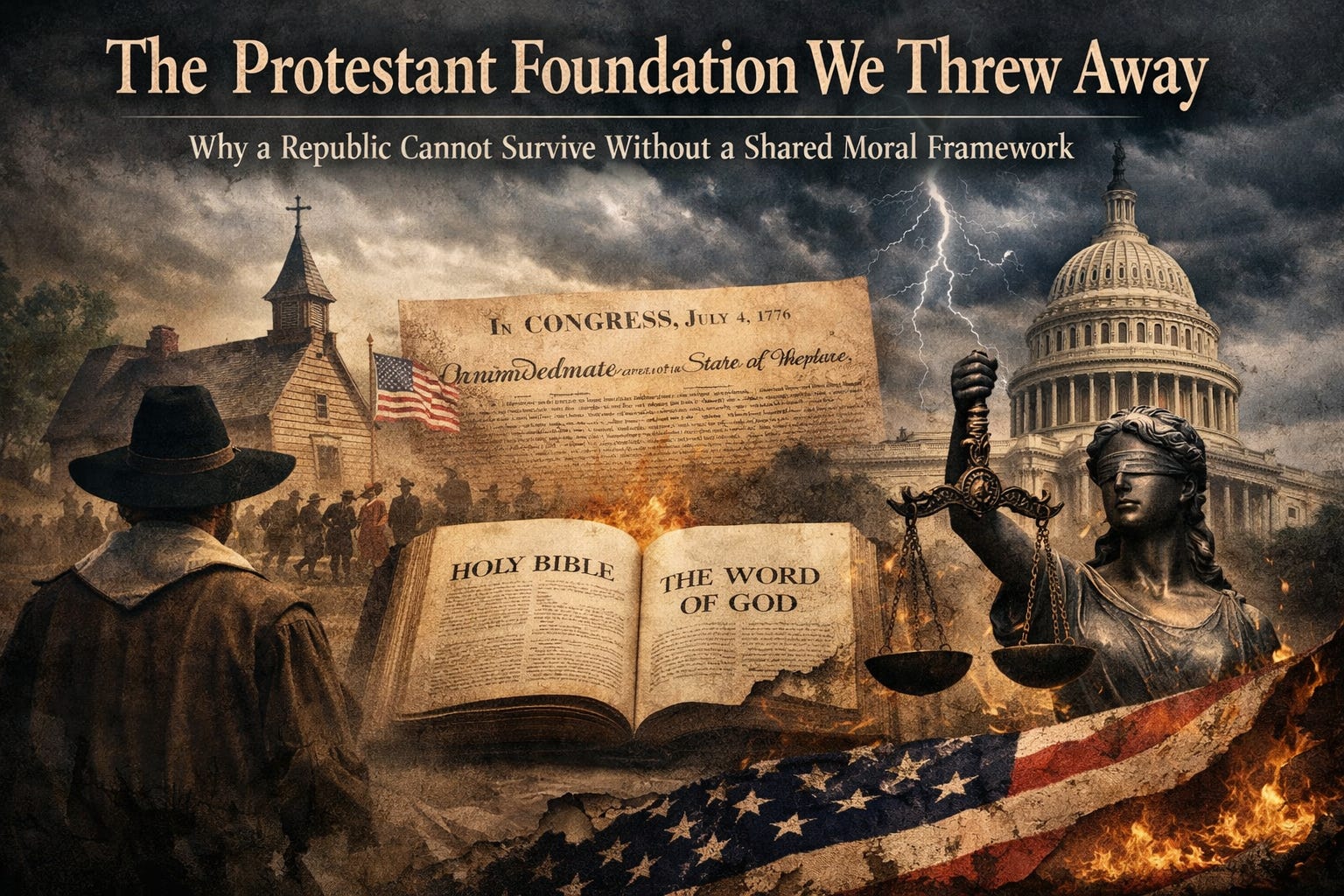
The Protestant Foundation We Threw Away
Ethic, Not Ethnicity: The Moral Glue a Republic Requires

I’m 66 years old.
I’ve lived long enough to watch this country praise its origins while quietly denying them.
My family has been here since the beginning. My 12-times great-grandfather, William White, stepped off the Mayflower in 1620 and signed the Mayflower Compact. That wasn’t a Hallmark moment. It was a covenant. In the presence of God. For the glory of God. For the advancement of the Christian faith.
No, God did not establish the covenant, but those who signed the Mayflower, were using these concepts to express the seriousness of what they were trying to do. Why they risked everything.
That matters.
Two centuries later, my fifth great-grandfather James Spooner rushed to Lexington and Concord in August 21, 1775 and my fourth great-grandfather Thomas Omans fought in the War for Independence. They weren’t fighting for “democracy.” They were fighting under a worldview shaped by Scripture, filtered through the Reformation, and articulated in the Declaration of Independence.
That Declaration spoke of rights endowed by the Creator. Not by Parliament. Not by a king. Not by “the people.” By God.
The men who fought that war were overwhelmingly Protestant. Scripture alone. Conscience bound to God. Suspicion of centralized power. Yes, a few Catholics participated, like Charles Carroll, but let’s not pretend this was some pluralistic experiment from the start. It wasn’t. It was a Protestant civilizational project.
And when the war was won, the framework that governed the new nation was the Articles of Confederation - the first Constitution.
Loose. Decentralized. State-driven. Suspicious of concentrated authority.
That wasn’t an accident.
If you’ve ever studied Geneva under John Calvin or the Dutch provinces, you understand the instinct. Keep authority close. Keep power thin. Don’t hand a distant central authority the tools to dominate you later.1
Under the Articles, Congress could not tax directly. It relied on the states. Major changes required near unanimity. It was clunky. It was inefficient. It was human-scale.
And here’s the part modern conservatives don’t want to touch: Several original states explicitly required Protestant belief for office. Others required Christian affirmation.2 None were religiously neutral in the modern sense. Oaths affirmed belief in God, in Scripture, in the Christian religion. Not perfect. Not pure. But there was a shared moral center.
You had what I would call a mono-ethic culture. A common moral vocabulary. That kind of shared trust is what makes decentralized systems workable.
Was it flawless? Of course not. Slavery was still there. Trade disputes existed. Debt problems mounted. Shays’ Rebellion exposed weaknesses.
But the instinct was right.
Then came 1787.
The Annapolis Convention called for amendments to improve the Articles. Amend. Not replace.
Instead, behind closed doors at the Constitutional Convention, the delegates produced something entirely new: the United States Constitution.
Stronger central government. Direct federal taxation. Broad commerce power. A real executive. A federal judiciary that could override states. A structure designed not around Protestant suspicion of power but around Enlightenment confidence in system design.
If you read Leviathan by Thomas Hobbes, you’ll understand the shift. Hobbes believed people, fearing chaos, would surrender liberty to a sovereign who promised order.
Now, the Framers did not crown a king. But they did create a central authority with the mechanisms to grow.
And grow it did.
Article VI banned religious tests for federal office. That is not a small clause. That is a civilizational pivot. The states had guardrails. The federal government would not. Any faith or no faith could now gain control over the whole via elections. No protections at all.
Montesquieu, whom they all read, warned that virtue is the spring of republics.3 The Reformers taught that self-government only works when the people are morally governed by Scripture.
But the Constitution contains no mechanism to preserve virtue. NONE.
It assumes virtue or replaces it with process.
And here we are.
Endless federal expansion. Competing factions fighting to control the center. Multi-ethic conflict in a system that assumes majority rule will somehow produce moral order. Sixty-five million babies legally murdered since Roe. Offensive wars launched by executive authority. Judges redefining morality.
And Christians still speak of the Constitution in hushed tones, as if it descended from Sinai.
It didn’t.
The Articles were not a biblical blueprint. But they preserved decentralization and assumed a shared Protestant moral order. The Constitution centralized power and severed it from explicit Christian guardrails.
I pray you can see the difference between the two Constitutions. I really do.
Those are historical realities. Not insults. Not rage. Just facts.
At 66, I’ve watched this unfold. I lived through the Cold War. I heard Reagan say, “Tear down this wall.” I watched the Berlin Wall fall. I watched federal power grow under Republicans and Democrats alike. Every president from Nixon forward expanded the machine.
That’s not an accident of personality. It’s structural.
If you build a centralized system in a society that eventually loses its shared ethic, the system becomes the battleground.
And whoever wins the majority controls the force.
That is where we are.
So if we want to recover anything meaningful, we have to be honest about the pivot point. 1620 was covenantal. 1776 still spoke in Creator language. 1787 was a structural shift toward centralized management.
You can admire the Framers if you like. Some, like Luther Martin, Robert Yates, John Lansing deserve admiration for going against the grain at the Convention. But you cannot pretend they simply “improved” the Protestant foundation that began in 1620. They replaced it with something else.
The question is not whether they were evil. The question is whether their system can preserve a Christian ethic long term or unmoored from Gods commands will eventually turn evil.
History is answering that for us.
And at some point, we either face that honestly, or we keep saluting a parchment while the moral order collapses around us.
That’s where I stand. I want to go back to the First Constitution, the Articles of Confederation with no central authority over the states.
Johannes Althusius, Politica, trans. Frederick S. Carney (Liberty Fund).
Francis Newton Thorpe, ed., The Federal and State Constitutions (1909)
Montesquieu, Spirit of the Laws, Book III, chap. 3 (Nugent trans.)
Hi Mark,
I generally agree with your sentiments and your overall point is valid and very important.
However, although the Articles of Confederation (AOC) was a much better governing document than the federal Constitution that replaced it, where the AOC went tragically astray was in its endorsement of the extant state Constitutions that, much the same as the U.S. Constitution, were inundated with biblically seditious Enlightenment components.
This shouldn't come as a surprise being at the time both documents were enacted, most of what was known as Christianity was a mix of both Christian and Enlightenment influences. Most who claimed to be Christians were neither Deists in the purest sense of the word, nor were they Christians in the biblical sense of the word. Best depicted as theistic rationalists.
Not to mention that even the Declaration of Independence was far being a biblical document, despite anti-Christ Thomas Jefferson mentioning his generic God and Creator - not the God of the Bible, per 2 John 1:7-11.*
As for the states' constitutions, consider the following. Read to the end for some biblically abominable samples for the state constitutions that are tragically very much the same as what was declared by men responsible for framing the biblically abominable federal Constitution:
"...In one of his many arguments on behalf of the Constitution, Madison revealed where ultimate power resides in a Constitutional Republic:
'As the people are the only legitimate fountain of power … it is from them that the constitutional charter under which the [power of the] several branches of government … is derived.'51
"Alexander Hamilton stated it similarly:
'The fabric of American empire ought to rest on the solid basis of THE CONSENT OF THE PEOPLE. The streams of national power ought to flow immediately from that pure, original fountain of all legitimate authority.'52
"This emphasis on the people by both the federalists and anti-federalists alike is evidence that they had lost sight of Yahweh and His ultimate authority. Such an emphasis on the people cannot be found anywhere in the Bible. George Washington (who presided over the Constitutional Convention) confirmed this self-originating authority in his “Farewell Address”:
'This government, the offspring of our own choice uninfluenced and unawed, adopted upon full investigation and mature deliberation, completely free in its principles, in the distribution of its powers, uniting security with energy, and containing within itself a provision for its own amendment, has a just claim to your confidence and support.'53....
"John Adams confessed to the same humanism regarding the States’ Constitutions:
'It will never be pretended that any persons employed in that service [the establishment of the States’ Constitutions] had interviews with the gods, or were in any degree under the inspiration of Heaven … it will forever be acknowledged that these governments were contrived merely by the use of reason and the senses.... Thirteen governments [of the original states] thus founded on the natural authority of the people alone….'55
"Following are samplings from some of the State Constitutions:
'…all power is inherent in the people and all free governments are founded on their authority.' (Pennsylvania, 1790, Article IX, Section II)
'...no authority shall, on any pretense whatever, be exercised over the people or members of this State, but such as shall be derived from and granted by them [the people].' (New York, 1777, Article I)
'…all political power is vested in and derived from the people only.' (North Carolina, 1776, "Declaration of Rights,” Article I)
'…power is inherent in them [the people], and therefore all just authority in the institutions of political society is derived from the people.' (Delaware, 1792, Preamble)
'All power residing originally in the people and being derived from them, the several magistrates and officers of government vested with authority – whether Legislative, Executive, or Judicial – are their substitutes and agents and are at all times accountable to them.' (Massachusetts, 1789, part I, Article V)
"A return to the States’ Constitutions and the Articles of Confederation will not solve America’s propensity for humanism...."
For more, see Chapter 3 "The Preamble: We the People vs. Yahweh" of free online book "Bible Law vs. the United States Constitution: The Christian Perspective" at https://www.bibleversusconstitution.org/BlvcOnline/blvc-index.html
*See free online book "Biblical Examination of the Declaration of Independence: Declaration of Liberty vs. Declaration of Independence" at https://www.bibleversusconstitution.org/declaration/declaration-index.html