
The Constitution, Originalism, and the Evangelical Prison of the Mind
Freeing Christian Political Thought from a Self-Imposed Constitutional Cage

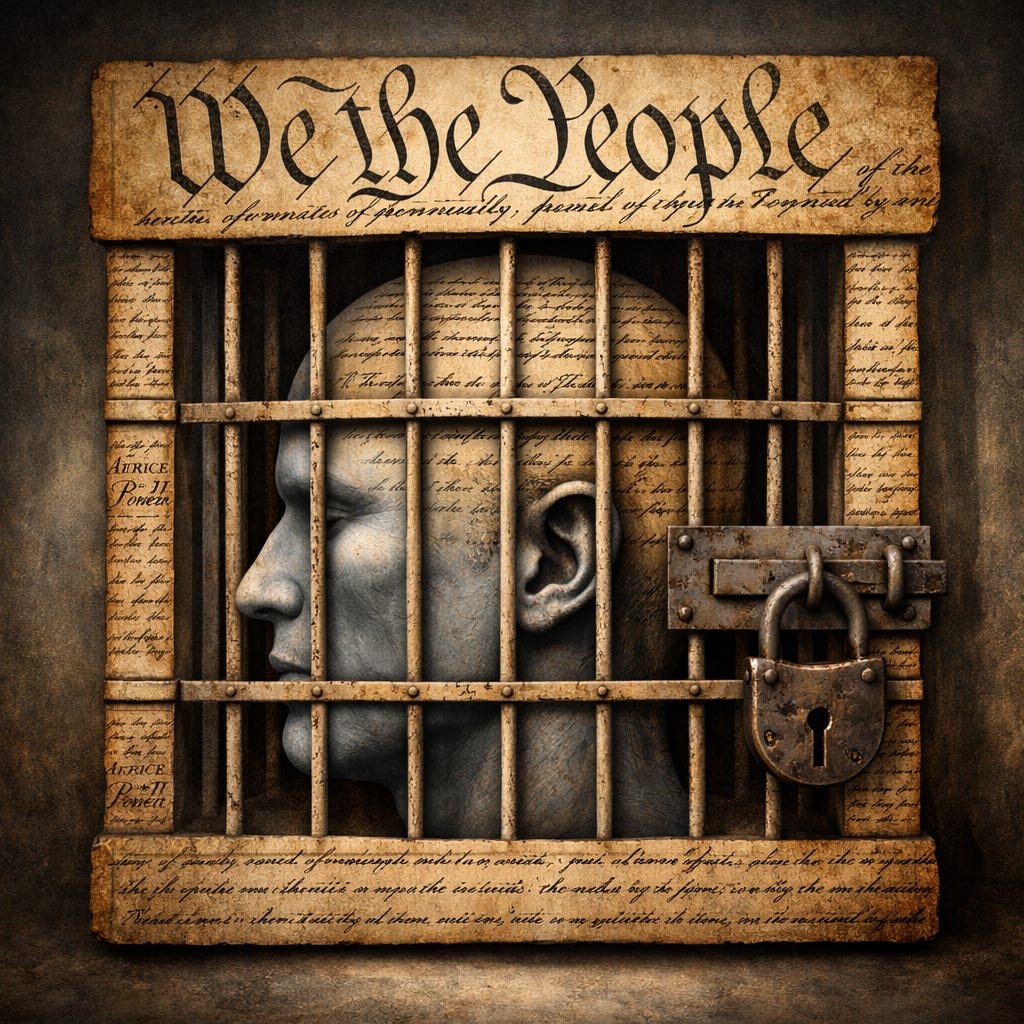
Politics is never static. It is always interpreted, across generations and even within the same moment, as circumstances change and power shifts. For the Christian who claims total devotion to Jesus Christ, refusing that work of interpretation is not an option. Jesus explicitly commands us to love God with our minds (Matthew 22:37).
That means thinking clearly when narratives collide with reality. And right now, the reality is unmistakable. We are staring at political outcomes that would have been unthinkable a generation ago, including the plausible rise of openly Neo-Marxist leadership, perhaps even a President AOC.
When our beliefs about a system no longer line up with what our eyes are telling us, something is wrong. It is not critical thinking to shrug our shoulders and blame the vague will of “the people.” It may be that the deeper problem is far more uncomfortable. We accepted a story because it sounded reassuring, because it was easier than thinking again, and because it allowed us to endure the growing sense of terror without questioning the framework that produced it.
Thus, we must ask, when, exactly, did evangelicals and conservative Christians become emotionally devoted to the U.S. Constitution?
Not aware of it.
Not respectful of it.
Not appreciative of it as a political framework.
But devoted to it.
Because if you were raised in the 1950s, 60s, or early 70s, you may share my memory. Sure, the Founders were historical figures, but we were not taught that they were saints. The Constitution was important, but not sacred. Civics was procedural, not theological. There was no sweeping narrative about America’s founding as a quasi-redemptive act of God, nor was there a widespread belief that questioning the Constitution bordered on moral rebellion.
That changes abruptly in the late 1970s and early 1980s.
Suddenly, the Founding becomes mythic.
The Framers become near-apostolic.
The Constitution becomes morally untouchable.
And a specific interpretive theory, modern originalism, becomes binding in a way no other political group treats it.
That timing alone should give us pause.
A historically recent devotion
This constitutional reverence did not emerge organically over 200 years. It arrived compressed into a single generation, alongside the political mobilization of evangelicals, the rise of the Moral Majority, and a wave of popular Christian literature that framed American history as providential destiny.
That does not make it false. But it does make it recent.
And recent sacred stories deserve scrutiny. Right?
The interpretive problem no one wants to face
Here is an uncomfortable but indisputable fact. The Framers did not codify an interpretive model for the Constitution.
They created a powerful central government, with supremacy, courts, and enforcement capacity, but they left no agreed method for determining meaning when disputes arose.
No hierarchy of interpretive authorities.
No binding role for intent versus text versus practice.
No rule for resolving contradictions.
No mechanism to prevent interpretation from becoming power.
Whether through haste, compromise, or overconfidence, they left the most dangerous question unanswered.
Who decides what this means once power is attached to it?
That omission alone guaranteed that interpretation would become political.
And NO, The Federalist Papers do not solve this
The Federalist Papers are often treated as if they do. They don’t.
They were just advocacy essays, written after the Convention, aimed at persuading skeptical ratifiers. They were not codified. They were not authoritative. James Madison, John Jay and Alexander Hamilton did not speak for the entire Convention, and they certainly did not bind future generations.
To treat the Federalist Papers as a timeless interpretive rulebook is historically indefensible, even if emotionally comforting. You must jettison this part of the narrative. You must. You simply cannot think critically, morally, biblically or clearly if you do not.
Worse, the early republic violated any supposed “fixed meaning” almost immediately. The Judiciary Act of 1789, the Whiskey Rebellion, Hamilton’s financial program, and Marshall’s jurisprudence all demonstrate that the Founding generation did not behave as if constitutional meaning were frozen.
That matters.
Originalism as a late, defensive theory
Modern originalism is not an ancient tradition rediscovered. It is a late 20th-century legal response to perceived judicial activism, articulated by figures like Raoul Berger, Robert Bork, and Edwin Meese. Their analysis wasn’t wrong, but their remedy has imprisoned the mind of millions of people.
The originalist theory was designed to constrain judges, not to serve as a moral theory of political legitimacy.
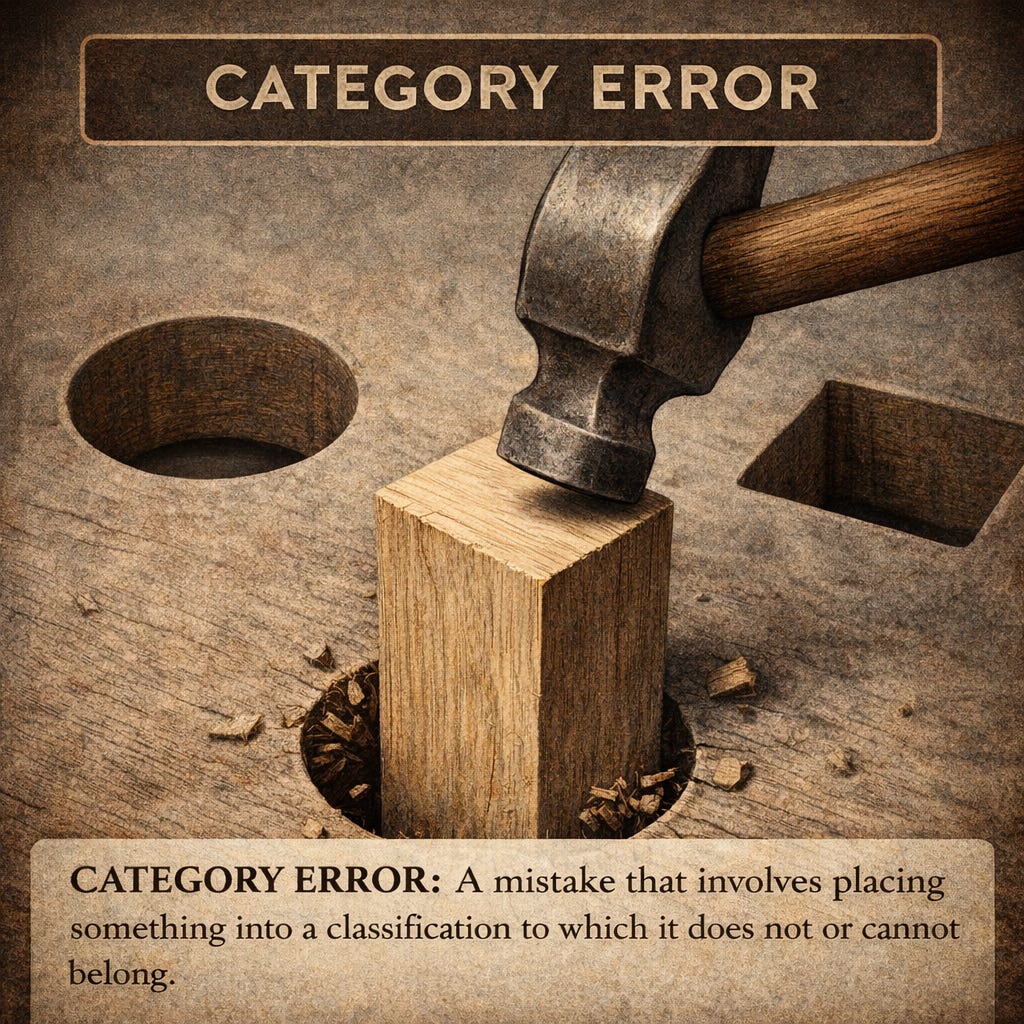
When evangelicals adopted originalism as a binding moral framework, they elevated a narrow legal tactic into a quasi-theological principle.
That category error has consequences.
Scalia’s honesty exposes the problem
Antonin Scalia, often venerated as the champion of originalism, was more honest than many of his admirers.
In A Matter of Interpretation,1 he openly conceded that originalism must yield to stare decisis, even when precedent contradicts proper constitutional analysis, all in the interest of stability.
Translated plainly, truth yields to order.
Larry Tribe was correct to observe that this is not originalism by its own definition. And Scalia knew it. He simply believed stability mattered more.
That admission should have shattered the evangelical myth of originalism as rigid, binding, and morally decisive.
It didn’t.
An asymmetry that guarantees defeat
Here is the problem no one wants to state plainly.
Evangelicals are virtually alone in treating originalism as morally binding.
Progressives do not.
Technocrats do not.
The administrative state does not.
The courts do not, except selectively.
Originalism has no final authority, no enforcement mechanism, and no universal acceptance.
Evangelicals are appealing to a referee who does not exist, while their opponents openly reject the premise that such a referee should exist at all.
That is not principled restraint. It is unilateral disarmament.
Design or dysfunction?
At this point, a question naturally arises.
Was this ideological confinement deliberately encouraged by political strategists and elites who understood that a morally earnest, anti-intellectual, highly organized religious community could be safely neutralized by binding it to procedure rather than first principles?
Or is this simply the result of evangelical anti-intellectualism, as Mark Noll2 famously argued combined with fear of disorder and a craving for reassuring narratives?
I am not prepared to answer that definitively.
But I am prepared to say this.
Whether by calculation or by cultural failure, the outcome is the same.
Evangelicals have placed themselves in a constitutional prison of the mind, tied to an interpretive theory no one else honors, defending a rigidity that the system itself does not observe.
And unless that devotion is abandoned, they will continue to lose, not because they lack passion or sincerity, but because they have mistaken procedural obedience for faithfulness.
That is not persecution.
It is captivity.
And captivity that is voluntarily embraced is the hardest kind to escape.
So, you want solutions? Step One, abandon your near religious devotion to a manmade construct called the U.S. Constitution. Honor God by doing so.
You are not sinning when you do.
Antonin Scalia, A Matter of Interpretation: Federal Courts and the Law, 138–139 (Princeton University Press, 1997).
“The scandal of the evangelical mind is that there is not much of an evangelical mind,” begins Mark A. Noll in his 1994 book The Scandal of the Evangelical Mind, a critical analysis of the decline of intellectual engagement within American evangelicalism.